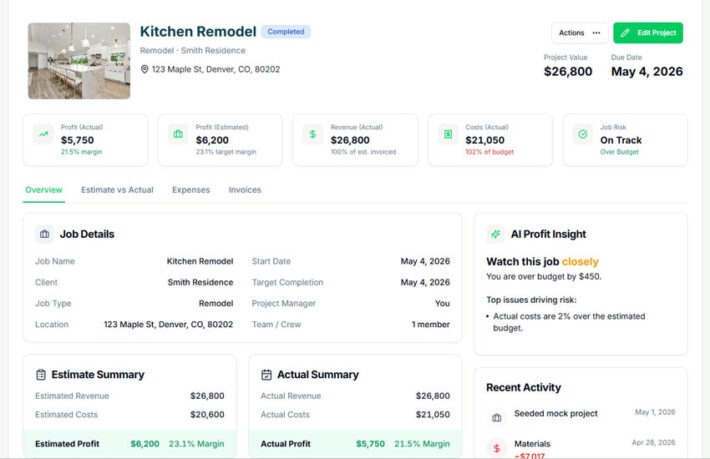
Job Costing Examples (Real Scenarios That Show Where Profit Is Made or Lost)

Understanding job costing in theory is one thing. Seeing how it plays out in real situations is where it starts to click.
Numbers on a spreadsheet can feel abstract. But when those numbers represent real work—real time, real materials, real decisions—you begin to see how small differences can completely change the outcome of a job.
This is where many businesses get caught off guard. Two jobs can look nearly identical on the surface, yet produce very different financial results. Without job costing, those differences remain invisible. With job costing, they become clear—and once they’re clear, they can be controlled.
The goal of this article is simple: walk through real-world scenarios so you can see exactly how job costing works in practice, where profit is gained or lost, and how to improve your results moving forward.
Scenario 1: The “Looks Profitable” Job That Isn’t
A contractor takes on a residential project priced at $5,000. Based on experience, it feels like a solid job. The scope seems straightforward, and the timeline appears manageable.
On paper, everything looks good.
But as the work unfolds, a few things happen. The job takes longer than expected due to minor complications. A few additional materials are purchased along the way. There’s also time spent coordinating with the client that wasn’t originally considered.
By the time the project is complete, the numbers look different:
- Labor: $3,200
- Materials: $1,200
- Other costs: $400
Total cost: $4,800
Revenue: $5,000
Profit: $200
What initially seemed like a strong job ends up producing a very thin margin.
The issue here isn’t the job itself—it’s the lack of visibility during execution. Without tracking costs in real time, there was no opportunity to adjust. The overruns weren’t dramatic, but they were enough to eliminate most of the profit.
Small gaps don’t feel significant in the moment, but they compound quickly.
Scenario 2: The Smaller Job With Better Profit
In contrast, consider a smaller job priced at $2,500. At first glance, it seems less attractive than larger projects. But this job is well-defined, efficiently executed, and carefully tracked.
The breakdown looks like this:
- Labor: $1,000
- Materials: $500
- Other costs: $200
Total cost: $1,700
Revenue: $2,500
Profit: $800
Despite generating less revenue, this job produces a much stronger margin.
The difference comes down to control. The scope was clear, the team worked efficiently, and costs were monitored throughout the process. There were no surprises, and no unnecessary spending.
Profit is not about size—it’s about efficiency and control.
Scenario 3: The Job That Slips Over Time
Some jobs don’t fail immediately. Instead, they drift.
A service business takes on a recurring project that is priced based on an initial estimate. The first few weeks go smoothly, but over time, small changes begin to accumulate. Additional requests are made, tasks take slightly longer, and inefficiencies begin to appear.
Individually, these changes seem minor. Collectively, they have a significant impact.
After several months, the numbers tell the story:
- Expected monthly cost: $2,000
- Actual monthly cost: $2,600
That difference of $600 per month may not seem alarming at first, but over the course of a year, it adds up to $7,200 in lost margin.
The challenge here is that the problem develops gradually. Without ongoing job costing, it’s easy to overlook these shifts. By the time the issue is recognized, the financial impact has already occurred.
Not all losses happen at once—many happen slowly and quietly.
Scenario 4: The Job That Improves Over Time
Not every story is about loss. Job costing also reveals opportunities for improvement.
A team takes on a type of project they complete regularly. Initially, the margins are average. The work is completed successfully, but there’s room for improvement.
By tracking each job carefully, the team begins to identify patterns. Certain tasks consistently take longer than expected. Some materials are being overused. A few steps in the process could be streamlined.
With that insight, adjustments are made.
Over time, the numbers shift:
- Labor hours decrease
- Material usage becomes more precise
- Overall efficiency improves
The result is a steady increase in profit per job.
This is where job costing becomes a strategic advantage. It’s not just about identifying problems—it’s about creating a feedback loop that drives continuous improvement.
When you measure consistently, you naturally improve.
Scenario 5: The Hidden Cost of Untracked Expenses
Another common issue arises when small expenses are not tracked consistently. These might include minor purchases, travel costs, or incidental supplies.
Individually, they seem insignificant. But across multiple jobs, they add up.
For example, a business might overlook $50–$100 in small expenses per job. Over the course of 50 jobs, that becomes $2,500–$5,000 in unaccounted costs.
Because these expenses are not captured, they are not included in job costing. This creates the illusion of higher profitability, which leads to pricing decisions that are not aligned with reality.
What you don’t track doesn’t disappear—it just becomes invisible.
The Common Thread Across All Scenarios
Each of these examples highlights a different challenge, but they all point to the same underlying issue: visibility.
When costs are not tracked consistently and connected to specific jobs, it becomes difficult to understand what is actually happening in the business. Decisions are made based on incomplete information, and outcomes become unpredictable.
Job costing provides the structure needed to bring clarity to these situations. It turns scattered data into actionable insight and allows you to see the true performance of each job.
Why Spreadsheets Struggle With Real Scenarios
In theory, all of these examples could be tracked in a spreadsheet. In practice, it becomes difficult to maintain accuracy as complexity increases.
Data must be entered manually, often after the fact. Multiple people may interact with the file, leading to inconsistencies. Updates are delayed, and small details are missed. Over time, the system becomes less reliable.
The challenge is not the tool itself, but the lack of integration. When projects, tasks, expenses, and reporting are not connected, it becomes difficult to maintain a clear and accurate picture.
How WorkBalance Brings These Scenarios Together
WorkBalance was designed to handle exactly these kinds of real-world situations. Instead of relying on disconnected tools, it brings everything into a single system where costs are automatically tied to projects as work happens.
This means:
- Labor, materials, and expenses are tracked in real time
- Costs are connected directly to specific jobs
- Budget vs actual performance is visible at any point
- Profitability can be monitored throughout the lifecycle of a project
By removing the need for manual reconciliation, WorkBalance ensures that the data reflects reality. This allows you to respond to changes quickly and make decisions with confidence.
The goal is not just to record data—it’s to make it usable.
Turning Insight Into Action
The value of job costing comes from what you do with the information. Once you can see how each job performs, you can begin to make adjustments.
You can refine your pricing, improve your processes, and focus on the types of work that deliver the best results. Over time, these changes compound, leading to a more efficient and more profitable business.
The difference between guessing and knowing is significant. When you know your numbers, you can operate with a level of precision that is difficult to achieve otherwise.
Final Thought
Every job tells a story. Without job costing, that story is incomplete.
By tracking costs and connecting them to real work, you gain a deeper understanding of how your business operates. You can see where money is being made, where it is being lost, and where there is room to improve.
That clarity is what allows a business to grow with confidence.
When you understand your jobs, you understand your business.
Take Control of Your Job Performance
WorkBalance helps you:
- Track real job costs in real time
- Connect expenses directly to projects
- Compare expected vs actual results
- Improve profitability with every job
Because every job should make your business stronger.