Why Most Small Businesses Don’t Know Their Profit (And How to Fix It)

Most small business owners believe they understand their profit.
They look at their bank account, see money coming in, and assume things are going well. They might even review a profit and loss statement occasionally and feel confident that everything is under control.
But when you ask a simple question—“How much profit did you make on your last project?”—the answer usually isn’t clear.
That’s the problem.
Most small businesses don’t actually know their profit. They estimate it, assume it, or discover it too late to do anything about it.
And the reason isn’t a lack of effort. It’s a lack of visibility.
The Illusion of Profit
One of the biggest traps small business owners fall into is confusing cash flow with profit.
Money comes in. Bills get paid. There’s money left over.
It feels like profit.
But in reality, that leftover money doesn’t tell the full story. It doesn’t account for all costs, timing differences, or hidden expenses that haven’t been fully tracked.
This creates an illusion.
You feel profitable… until something exposes the truth.
- A project runs longer than expected
- A large bill comes due
- Margins suddenly tighten
And now the numbers don’t make sense.
Profit isn’t what’s left in your bank account. It’s what remains after every cost is accounted for.
The Real Problem: Lack of Job-Level Visibility
Most businesses track their numbers at a high level.
They know:
- Total revenue
- Total expenses
- Overall profit
But they don’t know:
- Which jobs made money
- Which jobs lost money
- Where costs went over
Without this level of detail, profit becomes a guess.
You might have a profitable business overall, but certain jobs could be underperforming and dragging everything down.
And because you can’t see it clearly, you can’t fix it.
If you don’t understand profit at the project level, you don’t understand your business.
Where Profit Actually Disappears
Profit doesn’t disappear all at once.
It leaks.
- A few extra hours of labor
- Slightly higher material costs
- Missed or delayed expense tracking
- Inefficiencies that go unnoticed
Each one seems small.
But together, they erode your margins.
The worst part is that these issues are often invisible while the project is running. By the time they show up in reports, it’s already too late.
Small leaks create big problems when they go unnoticed.
The Timing Problem
Another major reason businesses don’t understand their profit is timing.
Most financial tracking happens after the fact.
- Expenses are logged later
- Reports are reviewed monthly
- Problems are identified once the job is complete
At that point, there’s nothing you can do.
The job is done. The costs are locked in. The outcome is final.
This creates a reactive business.
You’re constantly looking backward instead of forward.
If you only measure profit after the job is done, you’re not managing it—you’re reporting it.
Why Spreadsheets Make It Worse
Many small businesses rely on spreadsheets to track costs and profit.
At first, they work.
But as the business grows:
- Data becomes outdated
- Updates are inconsistent
- Different versions exist
- Visibility disappears
Spreadsheets require manual effort, and that effort breaks down under real-world conditions.
Instead of providing clarity, they create confusion.
Spreadsheets don’t fail because they’re bad—they fail because they can’t keep up with real-time work.
The Missing Link: Real-Time Cost Tracking
To truly understand profit, you need to see it while work is happening.
You should always be able to answer:
- What have we spent so far?
- Are we over budget?
- Are we still profitable?
This requires real-time tracking.
When costs are visible as they happen, you can:
- Catch overruns early
- Adjust before margins disappear
- Make better decisions on the fly
This is the difference between reacting and controlling.
Profit isn’t something you discover—it’s something you manage.
The Role of Job Costing
This is where job costing becomes critical.
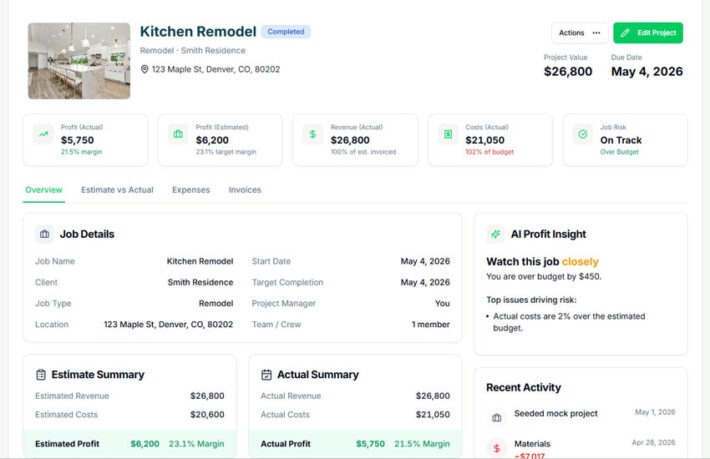
Job costing breaks your business down into individual projects and tracks all associated costs.
Instead of looking at your business as one number, you see it as a collection of jobs—each with its own performance.
This gives you clarity.
- You know which jobs are profitable
- You know where costs are going
- You know what needs to change
Without job costing, profit is vague.
With job costing, it becomes precise.
How WorkBalance Solves This
This is exactly the problem WorkBalance is built to fix.
Most tools separate project management from financial tracking. That disconnect is what creates confusion.
WorkBalance brings everything together.
With WorkBalance, you can:
- Track expenses per project in real time
- Connect costs directly to jobs
- Monitor budgets as work progresses
- See profit before the project is complete
This removes the guesswork.
Instead of wondering how your business is performing, you can see it clearly.
WorkBalance turns profit from a mystery into a measurable, controllable number.
What Changes When You Know Your Profit
When you gain real visibility into profit, your business changes.
You start making better decisions.
- Pricing becomes more accurate
- Projects are managed more tightly
- Inefficiencies are identified quickly
- Margins become consistent
Over time, this creates stability and growth.
Instead of reacting to problems, you prevent them.
Final Thought
Most small businesses don’t know their profit—not because they aren’t capable, but because they don’t have the right system.
They rely on high-level numbers, delayed reporting, and disconnected tools.
That combination makes profit unclear.
But it doesn’t have to be that way.
When you can see your numbers clearly, you can control your outcomes.
Take Control of Your Profit
WorkBalance helps you:
- Track costs per project in real time
- Connect work and finances in one place
- See exactly where your profit comes from
Because profit shouldn’t be a surprise—it should be something you control.