Job Costing for Service Businesses (How to Track Profit Per Job)

Running a service business often feels like controlled chaos. Jobs are coming in, teams are moving, invoices are going out—but when you stop and ask a simple question like “Which jobs actually made money?”, the answer isn’t always clear.
That’s the gap most businesses don’t realize they have.
Revenue is easy to track. Profit is not.
And without a clear understanding of job-level profitability, it becomes difficult to scale, price accurately, or make confident decisions about which work to take on. This is where job costing becomes essential—not as an accounting exercise, but as a core operating system for the business.
Why Job Costing Matters More in Service Businesses
Unlike product-based companies, service businesses operate in a constantly shifting environment. Every job has its own scope, timeline, and level of complexity. Even two projects that appear similar on the surface can produce completely different outcomes in terms of cost and profitability.
That variability introduces risk.
If you rely on general assumptions or past experience without validating the numbers, small miscalculations begin to stack up. Extra hours, untracked materials, or overlooked expenses quietly erode margins. Over time, those small gaps become significant losses.
When every job is different, tracking each one precisely is the only way to stay in control.
What Job Costing Actually Means
Job costing is often misunderstood as a back-office function, but in reality, it’s much more practical than that. It’s the process of tracking every cost associated with a specific job and comparing it to the revenue generated from that job.
At its simplest level, it answers one question:
👉 Did this job make money?
To get that answer, you need to connect all relevant costs directly to the work being performed. That includes labor, materials, subcontractors, and even a portion of overhead. When those elements are tracked consistently, you gain a clear picture of how each project contributes to your business.
The Problem With Only Looking at Revenue
It’s easy to fall into the trap of measuring success based on how much money comes in. A full schedule and steady cash flow can create the impression that everything is working.
But revenue alone doesn’t tell the full story.
A job that brings in $2,000 might seem like a win, but if it costs $1,800 to complete, the margin is razor thin. Meanwhile, a smaller job with lower revenue might actually deliver higher profit because it was completed more efficiently.
Without job costing, these differences remain hidden.
Revenue shows activity. Job costing reveals performance.
Breaking Down the Real Cost of a Job
Understanding job profitability requires breaking costs into their core components. Each one contributes to the total picture, and missing even one can distort the results.
Labor
Time is the primary driver of cost in most service businesses. Every hour spent on a job has a direct impact on profitability. This includes not only wages but also the efficiency of the team. Even slight overruns in time can significantly affect margins across multiple projects.
Materials and Supplies
Even service-based work often involves materials, whether it’s cleaning supplies, replacement parts, or consumables. These costs are frequently underestimated or tracked loosely, which makes it difficult to understand their true impact.
Subcontractors
Outsourcing work introduces another layer of cost that must be tied directly to the job. When subcontractor expenses are tracked separately, it becomes harder to evaluate the true cost of delivering the service.
Overhead
Expenses like software, insurance, and administrative time don’t belong to a single job, but they still need to be accounted for. Allocating a portion of overhead to each project ensures that your pricing reflects the full cost of doing business.
Why Traditional Tracking Methods Fall Short
Spreadsheets and manual systems are often the default approach for managing job costs. While they may work in the early stages, they quickly become unreliable as the business grows.
Manual entry creates delays and increases the risk of errors. Data gets updated inconsistently, and important details are missed. Because these systems are not connected, it becomes difficult to tie costs directly to specific jobs.
As complexity increases, the spreadsheet evolves into something that requires constant maintenance. Instead of simplifying operations, it adds friction.
A system that requires constant upkeep eventually becomes a liability.
The Importance of Real-Time Visibility
One of the biggest limitations of traditional tracking methods is the lack of real-time insight. By the time costs are recorded and reviewed, the job is already complete.
At that point, the information is no longer actionable.
Real-time visibility changes that dynamic. It allows you to monitor costs as they occur, identify issues early, and make adjustments before they impact profitability. This shift from reactive to proactive management is what separates high-performing businesses from the rest.
How Job Costing Improves Decision-Making
Accurate job costing doesn’t just improve financial reporting—it directly impacts how decisions are made across the business.
Pricing becomes more precise because it’s based on real data instead of assumptions. Project selection improves because you can identify which types of jobs deliver the best margins. Resource allocation becomes more efficient because you understand where time and money are being spent.
Over time, these improvements compound. The business becomes more predictable, more efficient, and more profitable.
Connecting Work and Financial Outcomes
One of the biggest challenges in service businesses is the disconnect between operational activity and financial results. Work is being completed, but the financial impact of that work isn’t always clear.
Job costing bridges that gap.
By connecting tasks, time, and expenses to specific projects, it creates a direct link between what your team is doing and how the business is performing. This alignment provides a level of clarity that is difficult to achieve with disconnected systems.
How WorkBalance Simplifies Job Costing
WorkBalance was designed to bring structure and clarity to project-based businesses. Instead of relying on multiple tools, it centralizes everything into a single system where projects, tasks, expenses, budgets, and reporting are all connected.
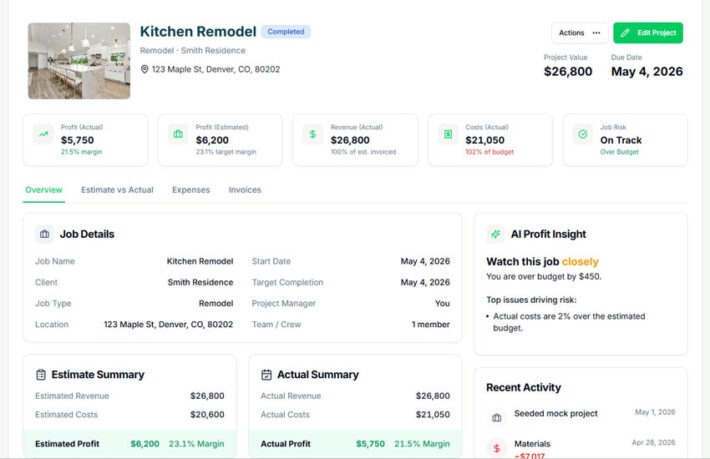
As work progresses, costs are captured automatically and tied to the appropriate job. This eliminates the need for manual tracking and reduces the risk of missed data. At any point, you can see how a project is performing against its budget and whether it is on track to be profitable.
This level of visibility allows you to make informed decisions in real time, rather than reacting after the fact.
The goal isn’t just to track your business—it’s to understand it while it’s happening.
Moving From Uncertainty to Control
Without job costing, profitability is often based on assumptions. Decisions are made with incomplete information, and outcomes are unpredictable. With job costing, those assumptions are replaced with data.
That shift changes everything.
It creates confidence in pricing, clarity in performance, and control over margins. Instead of wondering how a job turned out, you know exactly where it stands at every stage.
Final Thought
Growth in a service business doesn’t come from doing more work—it comes from doing the right work, at the right price, with the right level of control.
Job costing provides the foundation for that control.
It transforms your business from a collection of individual jobs into a system that consistently generates profit. And once that system is in place, scaling becomes far more predictable.
Understanding your jobs is the first step to growing your business.
Take Control of Your Job Profitability
WorkBalance helps you:
- Track costs per job in real time
- Connect labor, materials, and expenses
- Monitor budget vs actual instantly
- See profit as work happens
Because clarity is what turns work into profit.