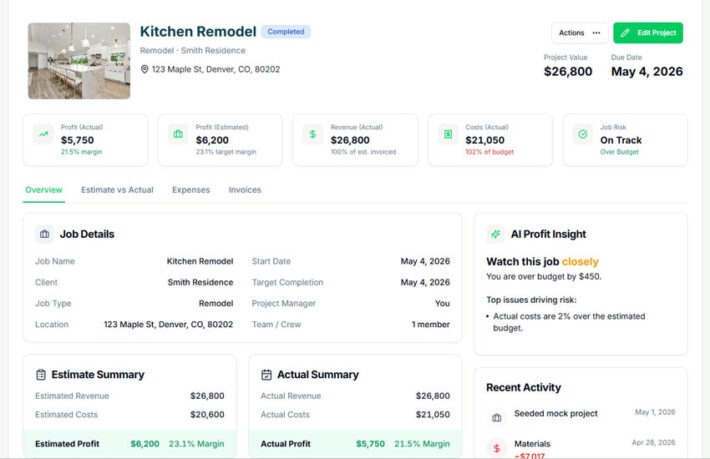
How to Track Material Costs Per Project (Without Losing Profit)

For most project-based businesses, materials are one of the largest—and most unpredictable—costs.
At first, tracking them seems simple. You buy supplies, keep receipts, maybe log them in a spreadsheet, and move on. But as you take on more projects, that approach starts to break down. Materials get purchased in bulk and used across multiple jobs. Receipts go missing. Costs get recorded late or not at all. By the time you review the numbers, the job is already finished.
And that’s when the real problem shows up.
You thought the job was profitable—but it wasn’t.
Material costs are one of the biggest reasons projects go over budget. Not because they are inherently high, but because they are rarely tracked accurately in real time. When you don’t know exactly what you’ve spent on materials for a specific project, you lose visibility into your true cost structure. And when that happens, profit becomes guesswork.
Tracking material costs correctly isn’t just an accounting task. It’s a core part of running a profitable business.
Why Material Costs Are So Hard to Track
Material costs are difficult because they don’t behave in a clean, predictable way. Unlike labor, which can be estimated based on hours and rates, materials fluctuate based on usage, availability, and scope changes.
You might estimate $500 in materials for a job, but during execution:
- Additional supplies are needed
- Prices increase
- Waste occurs
- Items are used across multiple jobs
These variables make it easy for costs to drift away from your original estimate. And unless you are tracking them consistently, you won’t notice until it’s too late to adjust.
Another challenge is timing. Materials are often purchased before, during, and even after a job. If those purchases are not tied directly to a project at the moment they happen, they become difficult to allocate later. This leads to inaccurate reporting and incomplete cost tracking.
Material costs don’t just need to be recorded—they need to be connected to the right job at the right time.
The Hidden Problem: Bulk Purchasing and Shared Materials
One of the biggest sources of confusion comes from bulk purchasing. Many businesses buy materials in larger quantities to save money, but those materials are then used across multiple projects.
Without a clear system, it becomes nearly impossible to answer questions like:
- How much of this material was used on Job A vs Job B?
- What is the true cost of each project?
- Are you overusing materials on certain jobs?
Instead of precise tracking, businesses rely on rough estimates or allocations. Over time, this leads to distorted job costs and unreliable profit calculations.
If you can’t allocate materials accurately, you can’t measure profitability accurately.
What Happens When Material Costs Aren’t Tracked
When material costs are not tracked properly, the impact is immediate and long-lasting.
Projects go over budget without warning because there is no visibility into spending during execution. Estimates become unreliable because they are based on incomplete historical data. Profit margins shrink because costs are consistently underestimated. Decision-making becomes reactive instead of proactive.
Perhaps most importantly, you lose confidence in your numbers. When you can’t trust your data, you can’t trust your business decisions.
What Proper Material Cost Tracking Looks Like
To manage material costs effectively, you need a system that does more than just record purchases. It must provide real-time visibility, accurate allocation, and clear connections between costs and projects.
At a minimum, your system should allow you to:
- Record material purchases as they happen
- Assign each purchase to a specific project
- Track usage across jobs when materials are shared
- Compare estimated vs actual material costs
- See the impact of material spending on overall profitability
This is not just about organization. It’s about control.
Step 1: Track Every Material Purchase
The first step is simple but critical: every material purchase must be tracked.
This includes:
- Supplies bought for a specific job
- Bulk purchases
- Emergency or last-minute purchases
The key is consistency. If even a small percentage of purchases are missed, your data becomes unreliable. Over time, those gaps compound and distort your understanding of project costs.
Tracking purchases as they happen—not days or weeks later—is what keeps your data accurate.
Step 2: Assign Materials to the Right Project
Recording a purchase is not enough. You must also assign it to the correct project.
This is where many systems break down. Receipts are stored, but they are not linked to specific jobs. Later, someone tries to reconstruct the allocation, often based on memory or rough assumptions.
Instead, every material cost should be tied to a project at the moment it is recorded. This creates a direct connection between spending and work, allowing you to see exactly how much each job is costing in real time.
Step 3: Handle Shared Materials Correctly
When materials are used across multiple projects, you need a way to allocate costs accurately.
There are a few approaches:
- Split costs based on usage
- Assign costs proportionally based on project size
- Track inventory and deduct usage per project
The method matters less than the consistency. What’s important is that shared materials are not ignored or lumped into a general category. They must be distributed in a way that reflects reality.
Step 4: Compare Estimated vs Actual Material Costs
Tracking costs is only part of the process. To improve your business, you must compare what you expected to spend with what you actually spent.
This comparison reveals:
- Where estimates were inaccurate
- Which projects consistently exceed material budgets
- Opportunities to reduce waste or improve purchasing
Over time, this feedback loop allows you to create more accurate estimates and better control your costs.
Without comparison, there is no improvement.
Step 5: Monitor Costs in Real Time
One of the biggest advantages of proper tracking is real-time visibility. Instead of waiting until the end of a project to see how you performed, you can monitor costs as the job progresses.
This allows you to:
- Identify overspending early
- Adjust purchasing decisions
- Control waste
- Protect your margins
Real-time tracking turns cost management from a reactive process into a proactive one.
Why Spreadsheets Fall Short
Many businesses attempt to track material costs using spreadsheets. While this can work initially, it quickly becomes difficult to maintain as complexity increases.
Spreadsheets rely on manual entry, which leads to delays and errors. They do not naturally connect purchases to projects, making allocation difficult. They also lack real-time visibility, meaning you are always looking at outdated information.
As your business grows, these limitations become more pronounced. What once felt like a simple solution becomes a source of confusion and inefficiency.
How WorkBalance Simplifies Material Cost Tracking
WorkBalance was designed to eliminate these challenges by connecting all aspects of your business in one system.
Instead of tracking materials separately, you can:
- Record expenses as they occur
- Assign them directly to projects
- Track usage across jobs
- Compare estimated vs actual costs instantly
- See the impact on profit in real time
Because everything is connected—projects, tasks, budgets, expenses, and reporting—you gain a complete view of your business without relying on manual processes.
You’re no longer guessing where your money is going—you can see it clearly.
The Result: Better Control, Better Profit
When you track material costs correctly, everything improves.
Your estimates become more accurate because they are based on real data. Your budgets stay on track because you can monitor spending as it happens. Your margins improve because you catch issues early instead of reacting late.
Most importantly, you gain confidence in your numbers. You know where your money is going, and you can make decisions with clarity.
Final Thought
Material costs are one of the easiest ways for profit to slip away unnoticed. They are small enough to be overlooked but significant enough to impact your bottom line.
Tracking them correctly is not optional—it’s essential.
The businesses that succeed are not the ones that avoid costs. They are the ones that understand and control them.
If you can track your material costs accurately, you can control your profitability.
Take Control of Your Project Costs
WorkBalance helps you:
- Track material costs per project in real time
- Connect expenses directly to jobs
- Compare estimated vs actual spending
- See profit as work happens
Because you shouldn’t have to guess where your money is going.