How to Prevent Budget Blowouts (Catch Problems Before They Become Expensive)

Budget blowouts don’t usually happen because of one big mistake.
They happen because of a series of small decisions that go unchecked.
A little more time spent here. A small extra purchase there. A quick workaround that feels harmless in the moment. None of these actions seem significant on their own. In fact, they often feel necessary just to keep things moving.
But taken together, they quietly push a project off course.
By the time the issue becomes obvious—when the numbers are finally reviewed—the damage is already done. The budget has been exceeded, the margin has been reduced, and there’s little left to do but absorb the impact.
The key to preventing budget blowouts is not avoiding all deviations. That’s unrealistic. The key is catching them early, when they are still small and manageable.
Why Budget Blowouts Feel Sudden (But Aren’t)
From the outside, budget overruns often appear sudden. A project that seemed fine suddenly shows a large gap between expected and actual costs.
But that “sudden” shift is usually the result of gradual drift.
Costs don’t jump from 100% to 130% overnight. They move incrementally—102%, 105%, 108%—each step small enough to ignore, but together significant enough to matter.
The problem is not the size of each individual change. It’s the lack of visibility while those changes are happening.
Budget blowouts are rarely surprises—they’re just unnoticed patterns.
The Real Risk: Invisible Progress
One of the biggest challenges in managing budgets is that progress is often visible, but cost is not.
You can see tasks being completed. You can see milestones being reached. You can see work moving forward.
But unless you’re actively tracking costs alongside that progress, you don’t see how much it’s costing to get there.
This creates a false sense of security. Everything looks on track because the work is progressing, but the financial side is drifting out of alignment.
Progress without cost visibility is misleading.
The Turning Point: Introducing Early Signals
Preventing budget blowouts starts with identifying early signals—indicators that a project is beginning to move off track.
These signals are not dramatic. They are subtle changes that, when noticed early, can be corrected easily.
Examples include:
- Time spent exceeding initial estimates
- Small but frequent additional purchases
- Tasks taking longer than expected
- Scope expanding without formal adjustment
On their own, these signals may not seem urgent. But they are the earliest indicators of a larger problem.
Recognizing them early is what creates the opportunity to act.
Step 1: Define What “On Track” Actually Means
You can’t detect a deviation unless you know what normal looks like.
This means defining expectations before the work begins:
- How much time should the job take?
- What is the expected cost?
- What margin are you aiming for?
These benchmarks create a reference point. Without them, every change feels subjective. With them, you can quickly identify when something is moving outside of expectations.
Step 2: Track Time and Costs Together
Time and cost are often tracked separately, but they are deeply connected.
Extra time usually means extra cost. Additional cost often reflects extra effort. When these elements are not viewed together, it becomes difficult to understand the full impact of changes.
Tracking them in parallel provides a clearer picture.
When time begins to exceed expectations, you can anticipate cost overruns before they fully materialize. This allows you to intervene earlier.
Step 3: Set Thresholds for Action
Not every deviation requires immediate action. The key is to define thresholds that trigger attention.
For example:
- A 5% increase in time might be acceptable
- A 10% increase might require review
- A 15% increase might require intervention
These thresholds remove ambiguity. Instead of relying on intuition, you have clear points at which action is required.
When thresholds are defined, decisions become easier.
Step 4: Make Adjustments in Real Time
The earlier you act, the smaller the adjustment needs to be.
If a project is slightly over budget, you might adjust how resources are allocated. If tasks are taking longer than expected, you might streamline the process or reassign work. If scope is expanding, you might renegotiate terms with the client.
These adjustments are only possible if the issue is identified early.
Waiting until the end of the project eliminates the opportunity to respond.
Step 5: Separate Scope Changes From Execution Issues
Not all budget overruns are the same.
Some are caused by scope changes—additional work that was not part of the original plan. Others are caused by execution issues—inefficiencies, delays, or mismanagement.
Treating these the same leads to confusion.
Scope changes should be addressed through pricing adjustments. Execution issues should be addressed through process improvements.
Understanding the difference allows you to respond appropriately.
Why Most Systems Fail to Prevent Blowouts
Many businesses attempt to manage budgets using spreadsheets or periodic reports. While these tools can capture data, they often lack the ability to provide timely insight.
The issue is not the availability of information—it’s the timing.
If data is only reviewed at the end of a project, it cannot influence the outcome. If updates are delayed, early signals are missed. If systems are disconnected, it becomes difficult to see the full picture.
Preventing blowouts requires a system that reflects what is happening now, not what happened later.
How WorkBalance Helps You Stay Ahead
WorkBalance was built to provide that level of visibility.
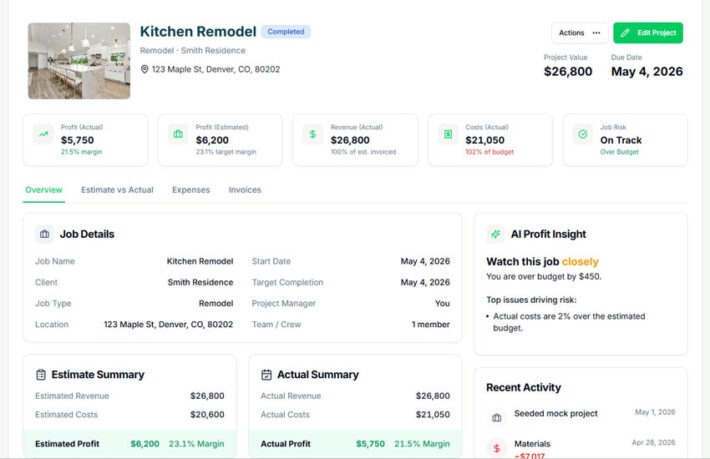
Instead of tracking budgets separately from execution, it connects projects, tasks, time, and expenses in a single system. As work progresses, the financial impact is updated in real time.
This allows you to:
- Compare expected vs actual costs continuously
- Identify early signs of drift
- Set and monitor thresholds
- Adjust before issues escalate
Because everything is connected, you don’t need to wait for reports or manually reconcile data. The information is available as the work happens.
You move from reacting to budget problems to preventing them.
The Compounding Effect of Early Intervention
One of the most powerful aspects of preventing budget blowouts is how small corrections compound over time.
Catching a 5% deviation early might save the entire margin of a project. Repeating that across multiple jobs can significantly improve overall profitability.
This is not about eliminating all risk. It’s about reducing the impact of risk through timely action.
From Oversight to Awareness
Preventing budget blowouts is not about tighter control—it’s about better awareness.
When you can see what’s happening as it unfolds, you don’t need to micromanage every detail. The system provides the insight needed to guide decisions.
This creates a more balanced approach to management—one that is responsive without being reactive.
Final Thought
Budgets don’t fail because of one big mistake. They fail because small issues go unnoticed for too long.
The difference between a controlled project and a blown budget is often just a matter of timing—when you notice the problem and how quickly you respond.
The earlier you see it, the easier it is to fix.
Take Control of Your Budgets
WorkBalance helps you:
- Track costs and time in real time
- Compare budget vs actual continuously
- Identify early warning signals
- Adjust before problems escalate
Because staying on budget starts with seeing the truth early.