The AI Profit System: How Smart Businesses Catch Losing Jobs Before It’s Too Late
The biggest challenge in managing profitability is timing.
Traditional systems tell you what happened after the fact. You review reports, analyze results, and try to understand where things went wrong. That process is useful, but it’s inherently reactive.
By the time you have the answer, the opportunity to fix the problem is gone.
What businesses actually need is a way to detect problems as they are developing—not after they’ve already impacted the outcome.
Profit doesn’t disappear all at once—it leaks out over time.
The Shift From Reporting to Prediction
Most financial tools are built around reporting. They collect data, organize it, and present it in a way that helps you understand past performance.
An AI profit system does something different.
It looks at patterns.
It analyzes how time is being spent, how costs are trending, how projects are progressing relative to expectations. Instead of waiting for a final number, it identifies when something is moving in the wrong direction.
This shift—from reporting to prediction—is what changes how businesses operate.
You’re no longer asking, “What happened?”
You’re asking, “What is about to happen?”
What an AI Profit System Actually Does
An AI profit system is not a replacement for your existing processes. It’s a layer of intelligence that sits on top of your operational data and continuously evaluates it.
At a practical level, it does three things:
1. Detects Early Warning Signals
It identifies when a job is beginning to drift away from its expected cost or timeline. This might include:
- Labor hours exceeding projections
- Expenses trending higher than planned
- Tasks taking longer than expected
- Scope expanding without adjustment
These signals are often too subtle for manual tracking to catch in real time.
2. Connects Data Across the Business
AI becomes powerful when it can see the full picture.
Instead of looking at time, costs, and progress separately, it analyzes how they interact. A small increase in time combined with a slight increase in cost might not seem significant on its own, but together they indicate a larger issue.
Insight comes from connection, not just collection.
3. Surfaces Actionable Insights
The goal is not just to detect problems—it’s to highlight them in a way that leads to action.
Instead of forcing you to dig through reports, the system brings attention to the jobs that need it most. It tells you where to focus before the problem grows.
The Real Advantage: Speed of Awareness
The value of an AI profit system is not in the data it collects—it’s in how quickly it helps you understand what’s happening.
Speed matters.
Catching a 3% cost deviation early is easy to fix. Catching a 20% deviation at the end of a project is not.
The earlier you see the problem, the more options you have.
You can adjust resources, streamline tasks, renegotiate scope, or change your approach. These small adjustments, made early, have a disproportionate impact on the final outcome.
Why Traditional Tools Fall Short
Spreadsheets and basic tracking systems are not designed to identify patterns in real time. They rely on manual input and periodic review.
Even with disciplined processes, there is always a delay between when something happens and when it is reflected in the data. That delay is enough to miss early warning signals.
Additionally, these tools typically operate in silos. Time tracking, expense tracking, and project management are handled separately, making it difficult to see how they influence each other.
This fragmentation limits the ability to detect issues before they escalate.
How WorkBalance Becomes an AI Profit System
WorkBalance provides the foundation that an AI profit system needs.
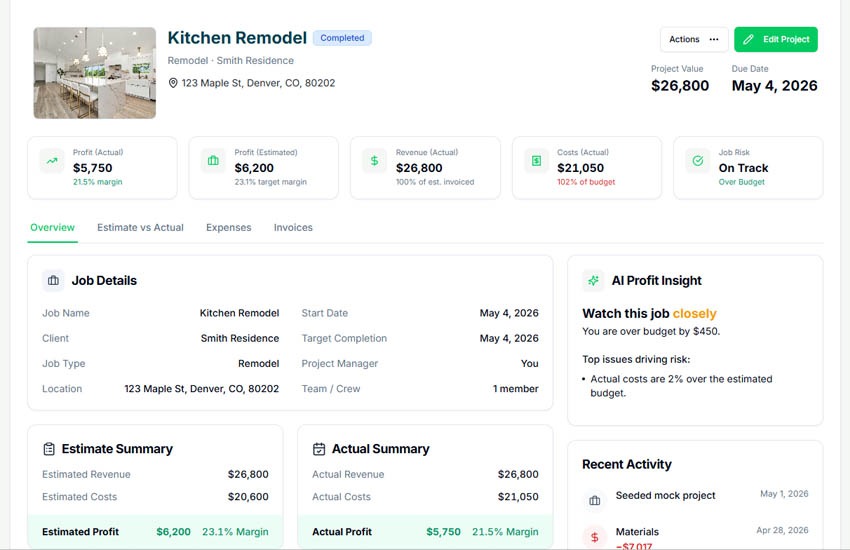
By connecting projects, tasks, time, expenses, and budgets in a single platform, it creates a unified data environment. This is what allows patterns to be identified and insights to be generated.
With everything in one place, WorkBalance can:
- Track how jobs are performing in real time
- Compare actual performance against expectations
- Identify when costs and time begin to drift
- Highlight the jobs that require attention
This turns your system from a passive tracker into an active decision-making tool.
You’re not just recording your business—you’re understanding it as it happens.
A Simple Example
Consider a contractor managing multiple jobs.
Without an AI profit system, each job appears to be progressing normally. Tasks are being completed, and nothing stands out as a major issue.
But beneath the surface:
- Job A is slightly over on labor
- Job B has a few extra material costs
- Job C is taking longer due to small delays
Individually, these issues seem minor. Together, they represent a pattern.
An AI-driven system identifies that pattern and surfaces it. It highlights that these jobs are trending toward reduced margins and need attention.
That insight allows the contractor to act early—before the impact becomes significant.
The Compounding Effect of Early Intervention
One of the most powerful aspects of this approach is how small corrections compound.
Fixing a minor inefficiency on one job might save a few hundred dollars. Doing that consistently across multiple jobs can result in thousands of dollars in preserved margin.
Over time, this creates a significant advantage.
The business becomes more predictable. Margins become more consistent. Decisions become more informed.
From Reactive to Proactive Operations
The introduction of AI into profit tracking changes the role of the business owner or operator.
Instead of reacting to results, you’re managing outcomes.
You’re no longer surprised by profit at the end of a job. You’re guiding it as the job progresses.
This shift reduces stress, improves confidence, and creates a more stable foundation for growth.
Final Thought
Every job has a trajectory.
It starts with an estimate, moves through execution, and ends with a financial result. Without visibility, that trajectory is unpredictable. With the right system, it becomes manageable.
An AI profit system doesn’t eliminate risk. It reduces the impact of risk by making it visible early.
The goal is not perfection—it’s awareness before it’s too late.
Take Control of Your Profit Before It’s Gone
WorkBalance helps you:
- Track jobs in real time
- Identify early warning signals
- Connect time, cost, and progress
- Protect your margins before they disappear
Because profit shouldn’t be discovered at the end—it should be managed throughout.