How to Estimate Jobs (Step-by-Step Guide for Small Businesses)

Most small businesses don’t lose money because they lack work.
They lose money because they estimate jobs incorrectly.
At first, estimating feels simple. You look at the job, think about how long it will take, add a number that feels right, and send it to the client. Sometimes you win the job. Sometimes you don’t.
But what matters isn’t whether you win the job.
It’s whether the job actually makes money.
And that’s where most businesses struggle.
Because once the work begins, reality sets in:
- Jobs take longer than expected
- Costs increase
- Scope expands
- Small expenses get missed
By the time the project is finished, the margin you thought you had is gone.
That’s the problem.
Estimating isn’t just about pricing—it’s about building a system that protects your profit.
Why Most Estimates Fail
The reason most estimates fail is simple:
They are based on assumptions, not data
You might estimate:
- 10 hours of labor
- $200 in materials
- Straightforward execution
But in reality:
- It takes 14 hours
- Materials cost $300
- Extra work is required
That gap is where profit disappears.
If your estimate isn’t based on real numbers, it’s just a guess.
What a Good Estimate Actually Does
A good estimate doesn’t just give a price.
It answers three critical questions:
- What will this job cost?
- How long will it take?
- Will it be profitable?
If your estimate can’t answer those, it’s incomplete.
Step 1: Define the Scope Clearly
Every estimate starts with scope.
This is where most mistakes begin.
You need to understand:
- What exactly is included
- What is not included
- What could change
Ask:
- What tasks are required?
- Are there unknowns?
- Are there potential add-ons?
The more detailed your scope, the more accurate your estimate.
Unclear scope leads to unexpected work—and lost profit.
Step 2: Break the Job Into Tasks
Once you define the scope, break the job down into smaller pieces.
Instead of estimating one big number, estimate:
- Individual tasks
- Time per task
- Resources needed
This creates clarity.
For example:
- Prep work → 2 hours
- Main work → 6 hours
- Cleanup → 1 hour
Now you’re not guessing—you’re building.
Step 3: Calculate Labor Costs
Labor is usually your largest cost.
Start with:
- Hourly rate
- Number of workers
- Time required
Example:
- 2 workers
- 8 hours
- $30/hour
Labor = $480
But don’t stop there.
You must include:
- Payroll taxes
- Overtime risk
- Inefficiency buffer
Underestimating labor is the #1 reason jobs lose money.
Step 4: Add Materials and Direct Costs
Next, include all direct costs:
- Materials
- Supplies
- Subcontractors
- Equipment
Be realistic.
Add a buffer for:
- Price increases
- Waste
- Unexpected needs
Small misses here can quickly erode profit.
Step 5: Include Overhead
This is where most businesses fail.
Overhead includes:
- Insurance
- Software
- Marketing
- Admin time
These aren’t tied to one job—but they still cost you money.
If you don’t include overhead, you’re underpricing every job.
A simple approach:
Add 10–30% to cover overhead
Step 6: Add Profit Margin
Now comes the most important part:
Profit
After all costs, you must add margin.
Typical ranges:
- 10% (low margin)
- 20–30% (healthy business)
Example:
- Total cost = $1,000
- Add 25% → Price = $1,250
This ensures you’re not just covering costs—you’re growing.
Step 7: Choose Your Pricing Model
Now that you know your cost, choose how to present it.
Common models:
Fixed Price
Best for repeatable work
Hourly
Best for unpredictable jobs
Per Unit (sq ft, room, etc.)
Best for fast quoting
The model doesn’t matter as much as the accuracy behind it.
Step 8: Build a Professional Estimate
Your estimate should include:
- Scope of work
- Pricing breakdown
- Timeline
- Terms
This does two things:
- Builds trust
- Prevents misunderstandings
A clear estimate wins better clients.
Step 9: Track Actual Results
This is the step most businesses skip.
After the job is complete, compare:
- Estimated cost vs actual cost
- Estimated time vs actual time
- Expected profit vs real profit
This is how your estimates improve.
Without feedback, your estimates never get better.
The Biggest Problem: Estimating Without a System
Most businesses estimate in isolation.
They:
- Use spreadsheets
- Write notes
- Rely on memory
But nothing connects:
- Projects
- Tasks
- Costs
- Profit
This is why estimates stay inaccurate.
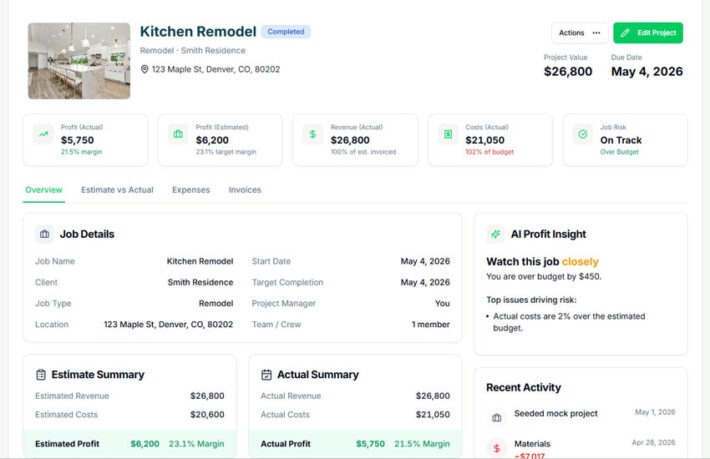
How WorkBalance Fixes Estimating
WorkBalance connects everything.
Instead of guessing, you can:
- Build projects from estimates
- Track tasks and time
- Capture real expenses
- Compare estimate vs actual
- See profit in real time
This turns estimating into a system—not a one-time guess.
Every job makes your next estimate better.
What Happens When You Estimate Correctly
When your estimates are accurate:
- You stop underpricing
- You avoid bad jobs
- You protect margins
- You build predictable revenue
You move from guessing…
To controlling your business.
Final Thought
Estimating isn’t about getting the number right once.
It’s about building a system that gets better over time.
Most businesses estimate → execute → move on.
The best businesses:
Estimate → track → improve → repeat
Take Control of Your Estimates
WorkBalance helps you:
- Build accurate job estimates
- Track real costs and time
- Compare estimate vs actual
- See profit before the job is done
Because estimating isn’t about winning jobs—it’s about making money on them.