Job Costing vs Accounting (What’s the Difference?)

Most small business owners think they understand their numbers.
They look at revenue, expenses, and maybe a profit and loss report. On paper, everything seems under control. But when they step back and ask a simple question—“Which jobs actually made me money?”—the answer isn’t clear.
That’s where the confusion between job costing and accounting shows up.
These two concepts are often used interchangeably, but they serve completely different purposes. Understanding the difference is not just a technical detail—it’s the difference between reacting to your business and actually controlling it.
At a high level, accounting tells you how your business performed. Job costing tells you why it performed that way.
What Is Accounting?
Accounting is the process of recording, organizing, and summarizing all financial activity in your business.
It answers questions like:
- How much revenue did we generate?
- What were our total expenses?
- What is our net profit?
Accounting operates at the business level. It looks at everything collectively and produces reports such as profit and loss statements, balance sheets, and cash flow reports.
This is critical for:
- Taxes
- Financial compliance
- Overall business health
But accounting has a limitation.
It tells you what happened, not what is happening right now.
Accounting is historical—it explains the past.
What Is Job Costing?
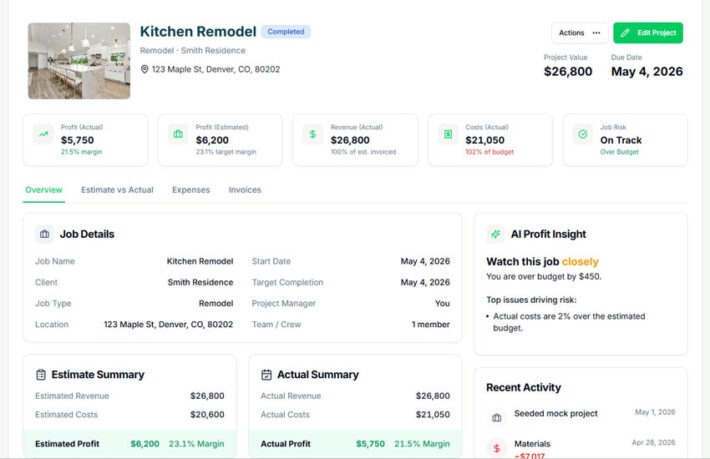
Job costing is the process of tracking costs at the project level.
Instead of looking at your business as a whole, job costing breaks everything down into individual jobs. For each project, you track:
- Labor
- Materials
- Subcontractors
- Equipment
- Overhead
This allows you to answer:
- Did this specific job make money?
- Where did costs go over budget?
- Which types of work are most profitable?
Job costing operates at the execution level. It connects directly to the work being performed.
Job costing is operational—it gives you visibility into your work as it happens.
The Core Difference
The simplest way to understand the difference is this:
- Accounting = business-wide financial reporting
- Job costing = project-level cost tracking
Accounting tells you:
“We made $100,000 this month.”
Job costing tells you:
“These three jobs made money, and these two lost money.”
Without job costing, you might think your business is doing well while certain projects are quietly destroying your margins.
Timing: The Most Important Difference
One of the biggest differences between job costing and accounting is timing.
Accounting is typically done:
- Monthly
- Quarterly
- Yearly
It’s structured around reporting cycles.
Job costing should happen:
- Daily
- In real time
- While the job is active
This timing difference is critical.
If you discover a problem in accounting, it’s already too late to fix it. The job is done, the money is spent, and the outcome is locked in.
With job costing, you can see problems as they develop.
- Labor trending too high
- Materials exceeding estimates
- Costs creeping beyond budget
And you can adjust before it impacts your profit.
Accounting explains results. Job costing gives you the chance to change them.
Why Small Businesses Get This Wrong
Most small businesses rely entirely on accounting.
They use tools to track expenses and generate reports, but they don’t connect those numbers back to specific jobs. Everything is aggregated.
This creates a dangerous blind spot.
You might see:
- Strong overall revenue
- Healthy-looking reports
But underneath, certain jobs are underperforming.
Without job costing:
- You don’t know which work is profitable
- You can’t improve your estimates
- You can’t control costs mid-project
You end up managing your business at the surface level.
The Real Impact on Profit
Profit doesn’t disappear in big, obvious ways.
It disappears in small, unnoticed details:
- Extra labor hours
- Slight material increases
- Missed expenses
- Inefficiencies in execution
Accounting captures these after the fact.
Job costing exposes them as they happen.
This is why businesses that rely only on accounting often feel like they are working hard but not getting ahead.
They’re measuring outcomes without controlling inputs.
Why You Need Both
This is not an either/or situation.
You need accounting and job costing—but for different reasons.
Accounting gives you:
- Financial structure
- Compliance
- High-level performance
Job costing gives you:
- Control over projects
- Real-time visibility
- Profit clarity
When used together, they create a complete system.
Without job costing, accounting is incomplete.
Without accounting, job costing lacks structure.
How WorkBalance Bridges the Gap
This is where most tools fall short.
Accounting software focuses on financial reporting.
Project management tools focus on tasks and timelines.
Very few systems connect work and money in a meaningful way.
WorkBalance is built to close that gap.
Instead of separating your projects from your finances, it brings them together.
With WorkBalance, you can:
- Track job costs in real time
- Connect expenses directly to projects
- Monitor budgets as work progresses
- See profit before the job is complete
This turns job costing into a natural part of your workflow instead of a separate task.
You’re no longer guessing—you’re seeing your business clearly as it operates.
A Simple Example
Imagine you run three projects this month.
Accounting shows:
- $120,000 revenue
- $100,000 expenses
- $20,000 profit
That looks solid.
But job costing reveals:
- Project A made $15,000
- Project B made $10,000
- Project C lost $5,000
Without job costing, you would never know Project C is a problem.
And if you keep taking similar jobs, your profit will slowly disappear.
Final Thought
The difference between job costing and accounting comes down to one thing: control.
Accounting helps you understand your business.
Job costing helps you run it.
If you only rely on accounting, you’re always looking backward.
If you use job costing, you can operate in real time.
The businesses that grow are the ones that don’t just track numbers—they act on them.
Get Control Over Your Numbers
WorkBalance helps you:
- Track job costs in real time
- Connect projects, budgets, and expenses
- See exactly where your profit is coming from
Because understanding your business isn’t enough—you need to control it.