What Is Job Costing? (Simple Explanation for Business Owners)

Most business owners don’t struggle because they aren’t working hard enough. They struggle because they don’t have a clear picture of where their money is going.
You complete projects, send invoices, and see revenue coming in. On the surface, everything looks healthy. But when you step back and look at your actual profit, something feels off. Margins are thinner than expected, and it’s not always clear why.
This is where job costing comes in.
Job costing is one of the most important concepts for any project-based business, yet it’s also one of the most misunderstood. Many owners think it’s something only large companies need, or something that lives inside accounting software. In reality, it’s a simple idea—but when done right, it changes how you run your entire business.
At its core, job costing answers one question:
How much does each job actually cost you?
Understanding Job Costing in Simple Terms
Job costing is the process of tracking all the costs associated with a specific job, project, or client.
Instead of looking at your business as a whole, you break it down by project. For each job, you track:
- Labor
- Materials
- Subcontractors
- Equipment
- Overhead
This allows you to see whether that specific job is profitable.
Without job costing, you’re operating at a high level. You might know your total revenue and total expenses, but you don’t know which jobs are making money and which ones are losing it.
If you don’t know your cost per job, you don’t know your profit—you’re just estimating it.
Why Job Costing Matters More Than You Think
Most small businesses rely on basic financial tracking. They monitor their bank balance, review invoices, and occasionally check reports. That gives a general sense of how the business is doing, but it doesn’t provide actionable insight.
The real decisions in your business happen at the job level:
- How much should you charge for the next project?
- Which jobs are worth taking?
- Where are you losing money?
Without job costing, those decisions are based on guesswork.
This leads to common problems:
- Underpricing jobs because past costs weren’t fully understood
- Accepting work that looks profitable but isn’t
- Missing small cost overruns that add up over time
Job costing turns guesswork into clarity.
What Happens Without Job Costing
If you’re not tracking job costs properly, you’re likely experiencing some version of this:
A project starts with a clear estimate. Everything seems under control. But as the job progresses, costs begin to creep up. A few extra labor hours here, a material cost increase there, maybe a small expense that doesn’t get recorded.
Individually, these don’t seem significant.
Collectively, they destroy your margin.
By the time the job is complete, you might realize the profit is far lower than expected—or gone entirely. At that point, there’s nothing you can do about it.
The biggest problem with poor job costing is timing—you find out too late.
The Key Components of Job Costing
To understand job costing, you need to understand what actually goes into a job.
Labor is typically the largest cost. This includes wages, but also payroll taxes, insurance, and inefficiencies that occur on real job sites. Materials are another major component, and they often fluctuate due to waste, delivery costs, and price changes.
Subcontractors must be tracked carefully, especially when scope changes occur. Equipment costs should be included whether rented or owned, as they represent real usage. Finally, overhead—things like admin time, vehicles, and software—must be accounted for to reflect the true cost of running the business.
When all of these are tracked consistently, you get a complete picture of what each job costs.
Missing even one category can distort your entire understanding of profitability.
Job Costing vs. General Accounting
This is where many business owners get confused.
Accounting tells you what happened.
Job costing tells you what’s happening.
Accounting is retrospective. It looks at past transactions and summarizes them into reports. That’s useful for taxes and overall financial health, but it doesn’t help you manage projects in real time.
Job costing is operational. It gives you visibility while the job is still active, allowing you to make adjustments before problems get worse.
Accounting reports the outcome. Job costing lets you influence it.
The Shift to Real-Time Job Costing
The biggest mistake small businesses make is tracking job costs after the fact.
They update spreadsheets at the end of the week or after the project is complete. At that point, the information is no longer actionable.
Real job costing happens in real time.
You should be able to answer, at any moment:
- How much have we spent so far?
- Are we over budget?
- Are we still profitable?
This is the difference between reacting and controlling.
If you can see the problem early, you can fix it. If you see it late, you absorb it.
Why Spreadsheets Stop Working
Many businesses start with spreadsheets. They’re flexible, easy to set up, and familiar.
But as soon as you start running multiple jobs, they begin to break down.
Updates become manual and inconsistent. Data becomes outdated. Different team members rely on different versions. Visibility disappears.
Instead of helping you manage your business, the spreadsheet becomes something you struggle to maintain.
Spreadsheets don’t fail because they’re bad—they fail because they can’t keep up with real-time work.
How WorkBalance Fits Into Job Costing
This is exactly the problem WorkBalance is built to solve.
Instead of tracking projects, tasks, expenses, and budgets in separate tools, WorkBalance connects everything in one place.
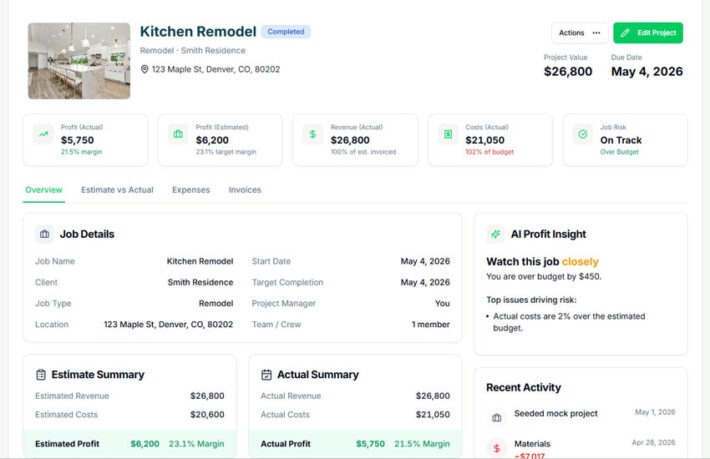
When you create a project, you can define a budget and track costs as they happen. Labor, materials, and expenses are tied directly to that job. As the project progresses, you can see your budget versus actual costs in real time.
This means you’re not waiting until the end to understand your profit—you’re seeing it as the work happens.
WorkBalance turns job costing from a manual task into a built-in part of your workflow.
What Job Costing Enables
When you implement job costing properly, everything in your business improves.
Your pricing becomes more accurate because it’s based on real data. Your projects become more controlled because you can see issues early. Your margins become more consistent because you’re making informed decisions.
Over time, this creates a feedback loop where each job makes the next one better.
The goal of job costing isn’t just tracking—it’s improving.
Final Thought
Job costing is not complicated, but it is essential.
It gives you visibility into the one thing that matters most in a project-based business: profit.
Without it, you’re working hard without knowing if that work is actually paying off.
With it, you gain control.
If you understand your job costs, you understand your business. Everything else builds on that.
Ready to Stop Guessing Your Profit?
WorkBalance helps you:
- Track job costs in real time
- Connect projects, budgets, and expenses
- See your profit as work happens
The difference between guessing and knowing comes down to your system.