How to Track Job Costs for Small Business (And Stop Losing Profit Without Knowing It)

MosMost small businesses don’t lose money because they don’t have enough work. They lose money because they don’t know what their work actually costs.
On the surface, everything looks fine. Projects are moving forward, invoices are going out, and revenue is coming in. But when you step back and look at the numbers, something doesn’t add up. Margins are thinner than expected. Cash flow feels tight. And there’s a constant sense that more work isn’t translating into more profit.
This is almost always a job costing problem.
Job costing is not an accounting exercise. It is the foundation of control in a project-based business. Without it, every estimate is a guess, every project carries risk, and every financial decision is based on incomplete information. The reality is simple: if you don’t know what each job costs while it’s happening, you don’t know if you’re making money until it’s too late to do anything about it.
What Job Costing Actually Means for a Small Business
At its core, job costing is the process of tracking all costs associated with a specific project. That includes labor, materials, subcontractors, equipment, and overhead. But what makes job costing powerful is not just what you track—it’s when and how you track it.
Most small businesses treat job costing as something they do after the fact. They look at a completed job, estimate what was spent, and try to determine whether it was profitable. This approach turns job costing into a reporting tool instead of a decision-making tool. By the time you have the answer, the job is already finished, and the outcome cannot be changed.
Effective job costing happens in real time. It gives you visibility into your financial position while the project is still active. It allows you to see trends as they develop, catch problems early, and make adjustments before they impact your bottom line.
If you only know your costs after the job is done, you are not managing your business—you are reviewing it.
Why Small Businesses Struggle With Job Costing
Small businesses operate differently from larger organizations. There are fewer people, fewer specialized roles, and far less time to manage systems. The same person who is overseeing the work is often responsible for tracking costs, communicating with clients, and keeping everything on schedule.
Because of this, job costing often becomes inconsistent or incomplete.
Costs are tracked in multiple places—spreadsheets, notebooks, receipts, and memory. Updates are delayed because there are more urgent tasks. Small expenses are overlooked because they don’t seem significant at the moment. Over time, these gaps accumulate and distort the true financial picture of the business.
The issue is not a lack of effort. It is a lack of a system that fits how small businesses actually operate.
When your process doesn’t match your workflow, it breaks under pressure.
The Real Cost of Not Tracking Job Costs Properly
When job costing is weak, the impact shows up in multiple areas of the business. Pricing becomes inconsistent because estimates are based on incomplete data. Projects run over budget without being noticed until it is too late. Cash flow becomes unpredictable because expenses are not aligned with expectations.
Most importantly, profit becomes unreliable.
You may think a job generated a 20% margin, but once all costs are accounted for, it may be closer to 8% or even negative. Without accurate job costing, there is no way to identify which jobs are driving profitability and which ones are quietly eroding it.
This creates a cycle where the business continues to take on work without improving its financial performance.
More work does not fix poor visibility—it amplifies it.
The Core Components of Job Cost Tracking
To track job costs effectively, every project must be broken down into consistent cost categories. This structure is what allows you to compare jobs, identify patterns, and improve over time.
Labor is typically the largest and most variable cost. It includes not just wages, but also payroll taxes, insurance, and inefficiencies that occur on real job sites. Materials are the next major category, and they often fluctuate due to waste, delivery fees, and price changes. Subcontractors must be tracked carefully, especially when scope changes or additional work is required. Equipment costs, whether rented or owned, should be accounted for consistently. Finally, overhead must be included to reflect the true cost of running the business.
When any of these categories are ignored or underestimated, the entire cost structure becomes unreliable.
Incomplete cost tracking leads to inaccurate decisions, even if everything else is done well.
The Shift From Tracking to Managing
The biggest mindset shift in job costing is moving from tracking what happened to managing what is happening.
Tracking is passive. It records data and summarizes outcomes. Managing is active. It uses data to influence decisions in real time.
To manage job costs effectively, you need to see how actual costs compare to your budget as the project progresses. This comparison reveals whether you are on track or deviating from expectations. If labor is trending higher than planned, you can investigate the cause and adjust accordingly. If materials are exceeding the budget, you can control future purchases or revisit the scope.
This level of visibility transforms job costing from a financial exercise into an operational tool.
Control comes from visibility combined with action.
Why Spreadsheets Break Down Over Time
Spreadsheets are often the starting point for job costing because they are accessible and flexible. For very small operations, they can be sufficient. But as soon as the business begins to scale, their limitations become clear.
Spreadsheets rely on manual updates, which introduces delays and inconsistencies. They are not designed for real-time collaboration, which makes it difficult for teams to stay aligned. As the number of projects increases, maintaining accuracy becomes more challenging, and the system becomes harder to trust.
The result is a tool that requires significant effort to maintain but still fails to provide the visibility needed to manage the business effectively.
When your system requires more effort than it delivers in value, it becomes a liability.
The Role of a Connected System
To track job costs effectively at scale, small businesses need a system where projects, budgets, expenses, and tasks are all connected. This integration ensures that every action taken on a project is reflected in its financial position.
With a connected system like WorkBalance, job costing becomes part of the natural workflow instead of a separate process. When expenses are recorded, they are automatically tied to the project. When labor is tracked, it contributes to real-time cost visibility. When budgets are updated, they reflect current conditions instead of static assumptions.
This eliminates the need to reconcile data across multiple tools and provides a single source of truth for the business.
When your system reflects reality in real time, your decisions become faster and more accurate.
How WorkBalance Simplifies Job Cost Tracking
WorkBalance is built specifically for project-based small businesses that need to connect their work and finances. Instead of forcing you to manage multiple tools, it brings everything into one place.
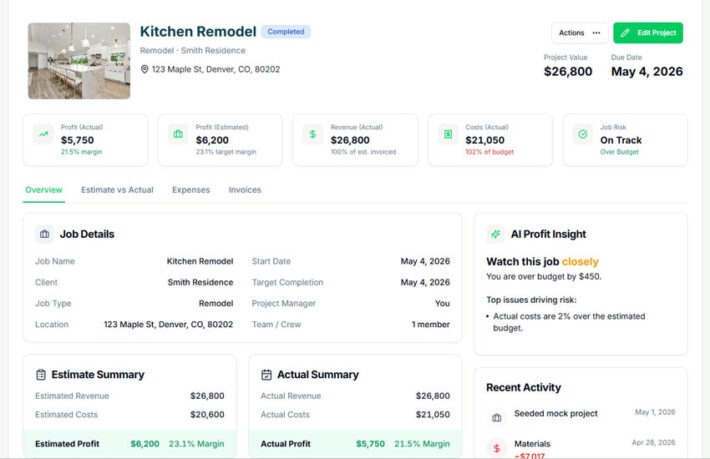
You can create a project, define a budget, and track expenses as they occur. Labor, materials, and other costs are all tied directly to the job, allowing you to see your financial position at any point in time. As the project progresses, you can compare budget versus actual costs and identify any deviations early.
This approach removes the friction that typically prevents small businesses from maintaining consistent job costing practices. It aligns the system with how the work actually happens.
The goal is not perfect tracking—it is consistent, real-time visibility.
Building a System That Improves Over Time
Job costing is not a one-time setup. It is a continuous process that becomes more valuable with each project.
Every completed job provides data that can be used to refine future estimates. By reviewing where costs exceeded expectations and where efficiencies were gained, you can improve your pricing and planning. Over time, this leads to more accurate budgets and stronger margins.
This feedback loop is what turns job costing into a competitive advantage.
The businesses that improve the fastest are the ones that learn from every project.
The Bottom Line
Tracking job costs is not about being more organized. It is about being more informed.
Small businesses that understand their costs operate with confidence. They price their work accurately, manage their projects proactively, and maintain consistent profitability. Those that do not are left reacting to outcomes they could have influenced earlier.
The difference is not complexity. It is visibility.
If you can see your numbers clearly, you can control your business. If you cannot, you are relying on luck.
Get Control Over Your Job Costs
If you are still managing your job costs through spreadsheets, notes, and disconnected tools, you are working harder than you need to.
WorkBalance gives you:
- Real-time job cost tracking
- Connected projects and budgets
- Clear visibility into profit as work happens
The difference between guessing and knowing comes down to the system you use.