Job Costing for Freelancers (How to Know If Your Work Is Actually Profitable)

Freelancing is often sold as freedom.
Freedom to choose your clients, set your schedule, and control your income. And in many ways, that’s true. But behind that flexibility is a reality that isn’t talked about enough: income alone doesn’t equal profit.
A freelancer can be fully booked, consistently busy, and still struggle financially.
That’s because the real question isn’t how much you earn—it’s how much you keep after every project is complete.
This is where job costing becomes essential. Not as a complicated financial exercise, but as a simple way to understand whether your work is actually paying off.
The Hidden Complexity of Freelance Work
Freelancers rarely think of themselves as running “projects,” but that’s exactly what each client engagement is. Every job has a scope, a timeline, and a set of costs associated with it.
The difference is that those costs are often less visible than they are in traditional businesses.
Instead of materials and large expenses, freelancers deal with:
- Time spent working on the project
- Time spent communicating with clients
- Software and tools required to complete the work
- Revisions and scope changes
- Administrative tasks like invoicing and follow-up
Individually, these may not seem significant. But together, they determine whether a project is profitable.
When your primary cost is time, every hour matters.
Why Freelancers Misjudge Profitability
A common pattern emerges in freelance work. A project is quoted at a certain price based on an estimate of how long it will take. The work begins, and everything seems on track.
Then small changes start to appear.
A client requests a few additional revisions. A task takes longer than expected. Communication back-and-forth adds extra time that wasn’t planned for. None of these changes feel major in isolation, but they extend the total time spent on the project.
At the end, the freelancer receives the agreed payment and moves on.
But if you calculate the actual hourly rate based on total time invested, the result is often lower than expected.
What started as a strong rate quietly becomes something much less.
Without tracking your time and effort accurately, your pricing becomes misleading.
What Job Costing Looks Like for Freelancers
Job costing for freelancers is simpler than it is for larger businesses, but the principles are the same. You need to track the total cost of delivering a project and compare it to the revenue it generates.
For freelancers, those costs typically fall into three categories:
Time
This is your primary cost. Every hour you spend on a project has value. That includes not only execution but also planning, communication, revisions, and administrative work.
Tools and Software
Subscriptions for design tools, project management platforms, communication tools, and other software are part of the cost of doing business. These expenses should be allocated across the projects that rely on them.
Overhead
Even as a freelancer, there are indirect costs—things like workspace expenses, internet, and general business overhead. While these are not tied to a single project, they still need to be considered when evaluating profitability.
A Simple Example
Imagine a freelancer takes on a project for $1,200. The initial estimate is that the work will take 20 hours, which would result in an effective rate of $60 per hour.
But once the project is complete, the actual breakdown looks like this:
- 20 hours of core work
- 5 hours of revisions
- 3 hours of client communication
- 2 hours of admin tasks
Total time: 30 hours
Now the effective rate is $40 per hour, not $60.
Nothing went “wrong” in the traditional sense. The project was completed successfully. The client is satisfied. But the financial outcome is different from what was expected.
This is the gap job costing reveals.
Why This Matters More Than You Think
Freelancers often focus on getting more clients or raising their rates to increase income. While those strategies can help, they don’t address the underlying issue if profitability per project is unclear.
If you don’t know how long your work actually takes, you can’t price it accurately. If you can’t price it accurately, increasing your rate may not have the impact you expect.
Understanding your true cost per project allows you to:
- Set rates with confidence
- Identify which types of work are most profitable
- Avoid projects that consume too much time
- Improve efficiency over time
The Role of Boundaries in Job Costing
One of the biggest challenges freelancers face is scope control. Without clear boundaries, projects tend to expand beyond their original definition.
Job costing makes this visible.
When you track the time spent on revisions and additional requests, you can see how much these changes impact your profitability. This insight makes it easier to set boundaries and communicate them to clients.
It also helps you structure your pricing more effectively, whether that means limiting revisions, charging for additional work, or building buffers into your estimates.
Clarity in your numbers leads to clarity in your boundaries.
Moving From Estimation to Awareness
Most freelancers rely on estimation when pricing their work. Estimation is necessary, but it becomes much more powerful when it is informed by real data.
By tracking actual time and costs, you create a feedback loop. Each project provides insight that can be applied to future work. Over time, your estimates become more accurate, and your pricing becomes more aligned with reality.
This shift from estimation to awareness is what allows freelancers to grow sustainably.
Why Spreadsheets and Memory Aren’t Enough
Some freelancers attempt to track their work using spreadsheets or mental estimates. While this can work in the short term, it often lacks consistency.
Time tracking may be incomplete. Costs may not be recorded accurately. Data may not be reviewed regularly. As a result, the system fails to provide reliable insight.
The issue is not effort—it’s structure.
Without a system that captures and organizes data consistently, it’s difficult to maintain visibility into your work.
How WorkBalance Supports Freelancers
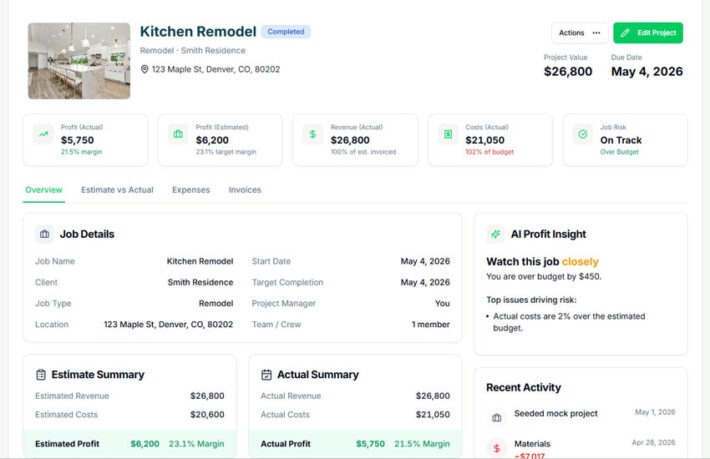
WorkBalance provides a simple way to connect your work with your financial outcomes. Instead of tracking time, expenses, and projects separately, everything is managed in one place.
Each project becomes a central hub where you can:
- Track time spent on tasks
- Capture any associated costs
- Monitor progress against your estimate
- See how your work translates into profit
Because the system is connected, you don’t need to manually piece together information. The data is available as you work, giving you a clear picture of your performance at any point in time.
You’re not just completing projects—you’re understanding them.
The Long-Term Advantage
Freelancers who understand their numbers operate differently. They price with confidence, manage their time more effectively, and make decisions based on data instead of assumptions.
Over time, this creates a significant advantage.
Projects become more predictable. Income becomes more stable. Growth becomes intentional rather than reactive.
Final Thought
Freelancing offers flexibility, but it also requires discipline. Without a clear understanding of your costs, it’s easy to confuse activity with progress.
Job costing provides the clarity needed to turn your work into a sustainable business.
It ensures that every project contributes to your goals, not just your workload.
Knowing your numbers is what turns freelancing into a business.