Real-Time Profit Tracking Explained (How to See Profit Before It’s Too Late)

There’s a moment in every business where the numbers finally get reviewed.
It might be at the end of a project. At the end of the week. Sometimes not until the end of the month. You open up your reports, look at revenue, subtract expenses, and try to understand what just happened.
That moment feels important—but it’s already too late.
Because profit is not something you discover after the work is done. It’s something that is either protected or lost while the work is happening. And if you can’t see it in real time, you don’t have the ability to influence it.
That’s the difference real-time profit tracking creates.
It shifts your business from looking backward to operating in the present.
Why Traditional Profit Tracking Falls Short
Most businesses rely on a delayed view of profit. Financial reports are generated periodically, often after all transactions have been recorded and reconciled. While these reports are useful for understanding overall performance, they don’t help with day-to-day decision-making.
The problem is timing.
By the time profit is calculated, the decisions that affected it have already been made. Labor has been spent, materials have been used, and the job is complete. If something went wrong, there is no opportunity to fix it—only to learn from it.
That learning is valuable, but it doesn’t protect the current job.
Delayed visibility creates reactive decisions. Real-time visibility creates control.
What Real-Time Profit Tracking Actually Means
Real-time profit tracking is not just faster reporting. It’s a fundamentally different way of understanding your business.
Instead of waiting for a final number, you monitor profitability as work progresses. Every cost, every hour, and every decision is reflected in an evolving view of the project’s financial performance.
This allows you to answer questions like:
- Are we still within budget?
- Is this job trending toward profit or loss?
- Do we need to adjust before it’s too late?
The goal is not precision down to the penny in every moment. The goal is awareness.
When you can see the direction of profit, you can change the outcome.
The Turning Point: From Static to Dynamic Thinking
Most businesses think of profit as a static result—a number that appears at the end of a process. Real-time tracking turns it into a dynamic signal.
Instead of asking, “Did we make money?” you begin asking, “Are we making money right now?”
That shift changes how decisions are made.
You become more aware of how time is being spent. You notice when costs start to drift. You begin to question whether certain tasks are necessary or efficient. Small adjustments start happening naturally because the impact is visible.
This is not about adding pressure—it’s about adding clarity.
Where Real-Time Tracking Makes the Biggest Difference
The impact of real-time profit tracking becomes most visible in situations where uncertainty is highest.
Projects With Changing Scope
When scope evolves during a project, costs often increase in ways that are difficult to predict. Without real-time tracking, these changes are absorbed without visibility. With it, you can immediately see how adjustments affect your margin and decide whether to proceed, renegotiate, or limit additional work.
Jobs With Tight Margins
When margins are already narrow, even small deviations can turn a profitable job into a loss. Real-time tracking highlights these deviations early, giving you the chance to correct course.
Teams Managing Multiple Projects
When multiple jobs are running at once, it becomes difficult to monitor each one using traditional methods. Real-time tracking provides a continuous view of performance across all projects, making it easier to identify which ones need attention.
The Role of Time in Profit Visibility
Time is often the least visible cost, yet it has the greatest impact on profitability. In many businesses, especially service-based ones, labor represents the largest expense.
When time is not tracked in real time, it becomes easy to underestimate how much effort is being invested in a job. Hours accumulate quietly, and by the time they are recorded, the opportunity to adjust has passed.
Real-time profit tracking brings time into focus. It connects hours worked directly to project outcomes, making the cost of time visible as it happens.
When time becomes visible, efficiency improves naturally.
Why Spreadsheets Can’t Deliver Real-Time Insight
Spreadsheets are often used as a central tool for tracking finances, but they are not designed for real-time operations. They rely on manual updates, which introduces delays and inconsistencies.
Even with disciplined processes, there is always a gap between when an event occurs and when it is recorded. That gap is enough to limit the usefulness of the data for immediate decision-making.
Additionally, spreadsheets do not connect different aspects of the business. Time tracking, expenses, and project management often exist in separate systems, requiring manual reconciliation to create a complete picture.
This fragmentation prevents a true real-time view.
What Real-Time Profit Tracking Requires
To track profit in real time, several elements need to be connected:
- Projects as the central structure
- Tasks and time tracking tied to those projects
- Expenses recorded as they occur
- Budgets that define expected costs
- Continuous comparison between expected and actual performance
When these elements are integrated, profit becomes a live signal instead of a delayed result.
How WorkBalance Enables Real-Time Visibility
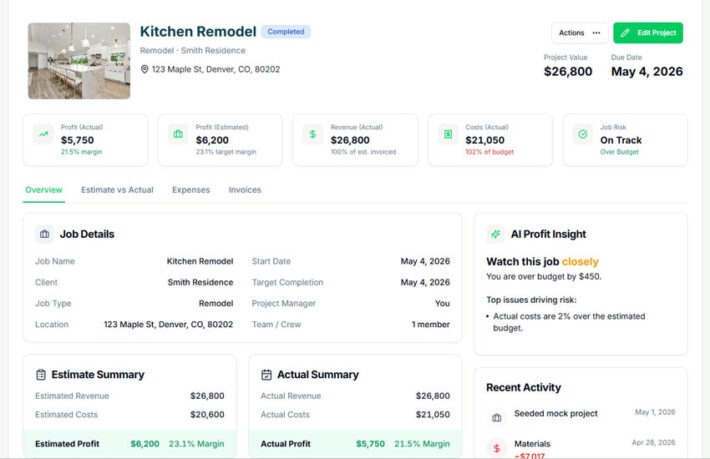
WorkBalance was designed to make real-time profit tracking practical for small and mid-sized businesses. Instead of relying on separate tools, it connects projects, tasks, expenses, budgets, and reporting in a single system.
As work progresses, every action—whether it’s logging time, recording an expense, or updating a task—feeds into the financial picture of the project. This creates an ongoing view of profitability without requiring manual reconciliation.
The system doesn’t just show you what happened. It shows you what is happening.
This allows you to make decisions with confidence, adjust when needed, and maintain control over your margins.
You move from reviewing profit to managing it.
The Behavioral Impact of Real-Time Awareness
One of the most interesting effects of real-time profit tracking is how it changes behavior. When people can see the financial impact of their work as it happens, they naturally become more mindful.
Teams begin to think differently about time. They become more efficient in how tasks are executed. They are more conscious of resource usage. These changes are not forced—they emerge from visibility.
Over time, this creates a culture of accountability and efficiency that is difficult to achieve through policy alone.
From Reaction to Control
The ultimate benefit of real-time profit tracking is control.
Without it, businesses operate in a cycle of reaction. They complete work, review results, and adjust for the future. With it, they can influence outcomes while they are still in motion.
This reduces risk, improves consistency, and creates a more predictable business.
Final Thought
Profit is not a single number at the end of a process. It is the result of countless small decisions made throughout a project.
If those decisions are made without visibility, the outcome is uncertain. If they are made with real-time insight, the outcome becomes manageable.
That is what real-time profit tracking provides.
It doesn’t just show you the result—it gives you the ability to shape it.
Take Control of Your Profit in Real Time
WorkBalance helps you:
- Track costs and time as work happens
- Connect projects directly to financial outcomes
- Monitor budget vs actual continuously
- See profit before the job is complete
Because profit should never be a surprise.