Contractor Profit Margins: What You Should Actually Be Making

Ask ten contractors what their profit margin is and you’ll get ten different answers. Most of them are wrong.
Not because they’re bad operators, but because they’re not measuring the right things.
Most contractors don’t have a pricing problem. They have a visibility problem. They think they’re making 20% on a job when in reality it’s closer to 8–10%. That gap is the difference between a business that scales and one that constantly feels tight on cash.
This guide breaks down what contractor profit margins should actually look like, why most businesses miscalculate them, and how to fix it.
What Is a Good Profit Margin for Contractors?
Profit margins vary depending on the type of work, but most fall into these ranges:
- Residential contractors: 10% – 20%
- Commercial contractors: 5% – 15%
- High-performing operators: 20%+
If you’re consistently under 10%, you’re operating with almost no margin for error. One bad job, one delay, or one miscalculation can wipe out your profit for the month.
If your margin is under 10%, you don’t have a pricing problem—you have a control problem.
Why Most Contractors Think They’re More Profitable Than They Are
The biggest issue isn’t revenue. It’s inaccurate cost tracking.
Most contractors underestimate:
- Labor (especially true cost with burden)
- Overhead (vehicles, insurance, admin time)
- Small expenses that add up across the job
Here’s a simple example:
You think:
- Revenue: $50,000
- Costs: $40,000
- Profit: $10,000 (20%)
But in reality:
- Labor overruns: +$3,500
- Materials increase: +$1,500
- Untracked overhead: +$2,000
Actual costs: $47,000
Actual profit: $3,000 (6%)
You didn’t lose money because of the job—you lost money because you didn’t see the job clearly.
The Three Drivers of Profit (And Where They Break)
Every contractor’s margin comes down to three core levers: pricing, cost control, and efficiency.
1. Pricing (Where Most Problems Start)
If your estimate is off, the job is already compromised before it begins.
Common issues:
- Underbidding to win work
- Not accounting for labor variability
- Ignoring contingency
If your pricing is wrong, no amount of execution will fix your margin.
2. Cost Control (Where Margin Disappears)
Even a well-priced job can go sideways without cost control.
This happens when:
- Labor runs longer than expected
- Materials increase or are wasted
- Change orders aren’t tracked properly
Profit isn’t lost all at once—it leaks out across small decisions.
3. Efficiency (The Hidden Multiplier)
Time is one of the biggest profit drivers in any project-based business.
Delays lead to:
- Increased labor costs
- Scheduling conflicts
- Extended overhead
Every extra day on a job reduces your margin whether you notice it or not.
How to Actually Improve Your Profit Margins
Improving margin isn’t about working harder. It’s about running a tighter system.
1. Know Your True Costs
You cannot improve what you don’t measure.
This means:
- Tracking labor accurately (including burden)
- Logging every material cost
- Allocating overhead consistently
If your numbers aren’t accurate, your decisions won’t be either.
2. Track Profit Per Job (Not Just Overall)
Looking at monthly or quarterly numbers isn’t enough.
You need to know:
- Which jobs are profitable
- Which jobs are breaking even
- Which jobs are losing money
Your business is a collection of jobs—if you don’t understand each one, you don’t understand your business.
3. Stop Underpricing to Win Work
This is one of the most common traps.
Winning a job at a bad price:
- Locks in low margins
- Increases pressure on execution
- Creates long-term instability
A bad job is worse than no job.
4. Standardize Your Estimating Process
If every estimate is different, your results will be inconsistent.
You need:
- Repeatable cost structures
- Historical data from past jobs
- Clear assumptions baked into pricing
Consistency in estimating leads to consistency in profit.
5. Use Past Jobs to Improve Future Margins
Every completed job is data.
Review:
- Where did costs exceed expectations?
- Where did you underestimate labor?
- Where did materials fluctuate?
Your past jobs should make your future jobs more profitable.
The Hidden Profit Killers Most Contractors Ignore
Even experienced contractors miss these:
- Change orders not properly tracked or billed
- Labor inefficiencies due to poor scheduling
- Material waste and overordering
- Downtime between job phases
- Administrative overhead creeping up
None of these individually seem significant, but together they destroy margin.
Most profit loss isn’t obvious—it’s cumulative.
What High-Performing Contractors Do Differently
The top operators don’t rely on gut feel.
They:
- Track every job in detail
- Review performance consistently
- Adjust pricing and execution based on data
They treat their business like a system, not a series of projects.
They don’t guess their margins—they engineer them.
Where Most Systems Fall Short
Many contractors rely on:
- Accounting tools
- Spreadsheets
- Disconnected systems
The problem is these tools show you what already happened.
They don’t show you:
- What’s happening now
- Where you’re trending
- Where profit is at risk
By the time traditional tools show a problem, it’s already too late to fix it.
The Shift: From Reactive to Real-Time
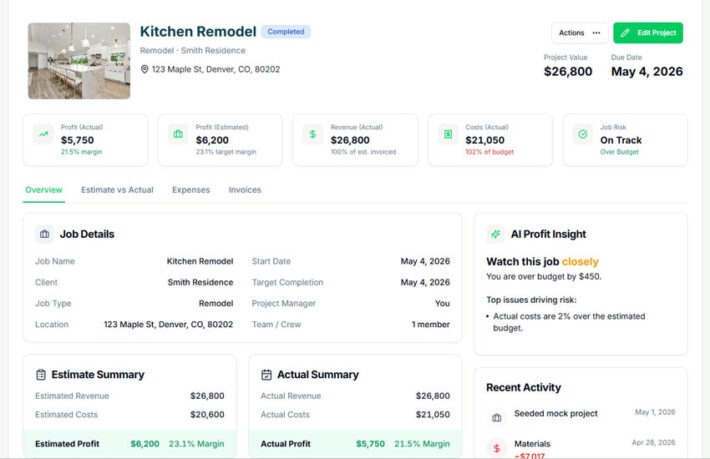
To actually control profit, you need real-time visibility.
That means:
- Tracking costs as they happen
- Comparing budget vs actual continuously
- Seeing margin while the job is still active
This is where systems like WorkBalance change how contractors operate.
Instead of waiting until the end of the job, you:
- See margin as work progresses
- Catch issues early
- Adjust before profit disappears
Real-time visibility turns profit from a result into a controllable outcome.
Frequently Asked Questions
What is the average profit margin for contractors?
Most fall between 10% and 20%, depending on the type of work and efficiency.
Why are my margins lower than expected?
Usually due to underestimating labor, ignoring overhead, or not tracking costs accurately.
How can I increase my margin quickly?
Focus on cost tracking, eliminate inefficiencies, and stop underpricing jobs.
Should I track profit per job or overall?
Both—but job-level tracking is what actually drives improvement.
The Bottom Line
Profit isn’t what’s left over at the end of a job.
It’s the result of decisions made before and during the job.
The contractors who consistently make money:
- Know their numbers
- Adjust early
- Operate with control
Everyone else finishes jobs and hopes the numbers work out.
If you’re not actively managing your margins, they’re managing you.
Want Better Control Over Your Profit?
If you’re relying on spreadsheets or after-the-fact accounting, you’re always going to be reacting.
WorkBalance was built for project-based businesses that need:
- Real-time job costing
- Connected budgets and expenses
- Clear visibility into profit as work happens
The fastest way to increase profit isn’t more jobs—it’s better control of the ones you already have.