Business Cost Tracking Mistakes to Avoid

Cost tracking rarely fails in obvious ways.
It doesn’t usually break because someone refuses to track expenses or because a business doesn’t care about its numbers. Most of the time, the system is there. Expenses are being recorded. Reports exist. The intention is right.
And yet, when decisions need to be made—pricing a job, evaluating profitability, or understanding where money is going—there’s hesitation. The numbers don’t feel reliable. Something seems off.
That’s because cost tracking doesn’t fail from lack of effort. It fails from small, repeated patterns that gradually distort reality.
Understanding those patterns is the first step to fixing them.
Mistake #1: Treating Cost Tracking as an Afterthought
In many businesses, cost tracking happens after the work is done. Receipts are gathered later. Expenses are entered in batches. Time is reconstructed from memory. The system becomes something that reflects the past rather than the present.
This delay creates a gap between what is happening and what is recorded. That gap introduces errors, missing data, and assumptions. Over time, the numbers begin to drift away from reality.
The issue is not that costs aren’t tracked—it’s that they aren’t tracked when they matter.
When cost tracking is delayed, accuracy becomes optional.
Mistake #2: Tracking Expenses Without Context
Recording expenses is only part of the equation. The real value comes from understanding what those expenses are tied to.
When costs are logged without being connected to specific projects, clients, or activities, they lose meaning. You may know how much was spent overall, but not what that spending produced.
This creates a disconnect between effort and outcome. Decisions become harder because the relationship between cost and value is unclear.
Cost tracking should not exist in isolation. It should be anchored to the work that generated it.
Mistake #3: Overcomplicating the System
It’s easy to assume that more detail leads to better tracking. Businesses create complex categories, detailed spreadsheets, and layered processes in an attempt to capture every possible data point.
But complexity often leads to inconsistency.
When a system becomes difficult to use, people avoid it or use it incorrectly. Data entry slows down, participation drops, and the quality of information declines.
A system that looks perfect on paper can fail in practice if it’s too complicated to maintain.
If your system requires too much effort, it won’t be used consistently.
Mistake #4: Ignoring Small Expenses
Large costs are easy to track. They stand out, require approval, and are difficult to overlook. Smaller expenses, on the other hand, tend to slip through the cracks.
These might include minor purchases, quick fixes, or small recurring costs. Individually, they don’t seem significant. Collectively, they can have a meaningful impact.
When small expenses are not tracked consistently, they create an illusion of higher profitability. Pricing decisions are then based on incomplete data, which leads to tighter margins over time.
Small costs don’t stay small when they’re repeated across multiple projects.
Mistake #5: Separating Time From Cost
In many businesses, time tracking and expense tracking are treated as separate activities. Time is recorded in one system, while costs are tracked in another. The connection between the two is often assumed rather than measured.
This separation creates blind spots.
Time is one of the most significant costs in any business. When it is not directly linked to projects and expenses, it becomes difficult to understand its true impact. Hours accumulate without clear visibility into how they affect profitability.
Bringing time and cost together is essential for accurate tracking.
Mistake #6: Relying on Memory Instead of Data
When systems are inconsistent, people naturally fill in the gaps with memory. They estimate how long something took or approximate how much was spent. While this may seem efficient in the moment, it introduces uncertainty.
Memory is not a reliable source of data, especially when dealing with multiple projects and ongoing work. Small inaccuracies compound over time, leading to distorted results.
A system that depends on memory will always produce incomplete insight.
Mistake #7: Reviewing Costs Too Late
Cost tracking often ends with a report—something that summarizes what has already happened. While these reports are useful, they are inherently reactive.
By the time the numbers are reviewed, the opportunity to influence the outcome has passed.
This approach limits the value of cost tracking. It turns it into a diagnostic tool rather than a decision-making tool.
If you only review costs at the end, you can’t change the result.
Mistake #8: Failing to Create a Feedback Loop
Tracking costs is only valuable if the information is used to improve future decisions. Without a feedback loop, the same mistakes are repeated.
Businesses may track expenses consistently, but if they don’t compare those expenses to estimates, budgets, or expectations, the data remains static. There is no mechanism for learning or adjustment.
A feedback loop connects past performance to future planning. It turns data into insight and insight into action.
The Pattern Behind All These Mistakes
Each of these mistakes may seem different, but they share a common theme: disconnection.
Costs are disconnected from time. Expenses are disconnected from projects. Data is disconnected from decisions. The system exists, but the pieces don’t work together.
When these connections are missing, clarity disappears. And without clarity, control becomes difficult.
What Effective Cost Tracking Looks Like
A strong cost tracking system doesn’t eliminate complexity—it organizes it.
It captures information as it happens, connects that information to the right context, and makes it visible in a way that supports decision-making. It is consistent without being rigid, detailed without being overwhelming.
Most importantly, it aligns with how the business actually operates.
When a system reflects real workflows, it becomes easier to maintain. Data becomes more accurate. Decisions become more informed.
How WorkBalance Addresses These Challenges
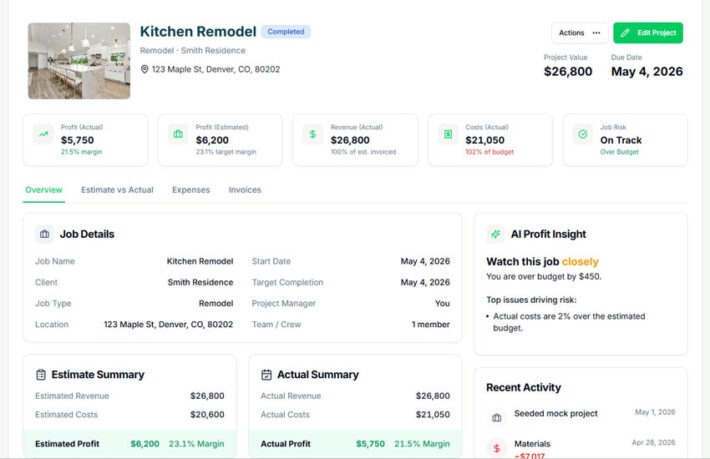
WorkBalance was built to remove the disconnects that cause cost tracking to fail. Instead of relying on separate tools and manual processes, it brings projects, tasks, expenses, budgets, and reporting into a single environment.
Costs are captured as they occur and automatically tied to the relevant work. Time and expenses are connected, providing a complete view of each project’s performance. Budget comparisons happen continuously, not just at the end.
This integration eliminates the need to reconstruct data or rely on assumptions. The system reflects what is happening in real time, allowing for immediate insight and action.
Cost tracking becomes part of the workflow, not a task added on top of it.
From Mistakes to Momentum
Avoiding these mistakes does more than improve accuracy—it changes how the business operates.
When costs are tracked consistently and connected to outcomes, patterns begin to emerge. You see which types of work are most efficient, where resources are being used effectively, and where adjustments are needed.
These insights create momentum. Each project becomes an opportunity to refine the process, improve margins, and build a more predictable business.
Final Thought
Cost tracking is not about perfection. It’s about clarity.
Mistakes happen when systems are disconnected, delayed, or overly complex. Fixing those issues doesn’t require more effort—it requires a better structure.
When that structure is in place, the numbers start to make sense. Decisions become easier. And the business moves forward with confidence.
Clarity is not a result of more data—it’s the result of better connection.
Take Control of Your Cost Tracking
WorkBalance helps you:
- Capture costs as they happen
- Connect expenses directly to projects
- Align time, cost, and outcomes
- Turn data into real-time insight
Because tracking costs should lead to better decisions—not more confusion.